
SAFETY & WORKWEAR
Smart Tool Solution · Safety & Workwear · Heated Gear
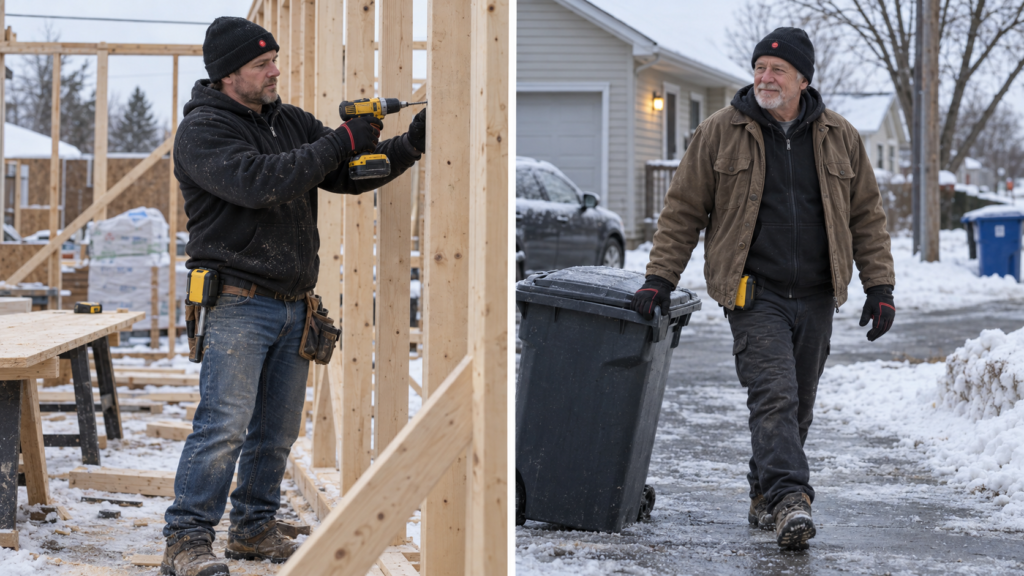
Seven in the morning, January, temperature below freezing. The mail carrier is already on the second street, hands going in and out of mailboxes. The construction crew is framing with the wind blowing straight at them. The police officer has been standing at the intersection for an hour, and the delivery driver has climbed in and out of the truck twenty times. For these people, staying home isn’t an option. The cold is part of the shift, every day, for months.
At home, the bill is smaller, but it’s the same one. It’s clearing the driveway before heading to work, fixing the fence the wind knocked down, or spending Saturday in an unheated garage. In every one of these cases, your fingers stiffen first, then your ears start to ache, and the work gets slower and clumsier. The natural reaction is to put on more clothes. That helps you hold out, but it doesn’t solve the problem. What solves it is bringing heat to the places where your body loses it, and today that heat comes from a battery.
Why Cold Cuts the Workday Short
The human body has clear priorities in the cold. To protect your vital organs, it reduces blood flow to your extremities. That’s why your fingers are the first to get cold, and your dexterity goes with them. Holding a small screw, tightening a clamp or squeezing a tool trigger gets harder by the minute, and every task takes longer.
Your head and ears are another sensitive spot. They’re exposed to the wind, and the discomfort there makes your whole body feel colder than it really is.
The usual solution is to pile on layers. That works for standing still, but it gets in the way of working. Two thick sweaters and a heavy coat limit how you move your arms, get too hot when you exert yourself and turn cold when you stop. And very thick gloves keep out the cold, but they take away the feel your tools require.
Heat Where It Matters, Without Extra Layers
Heated gear solves this a different way. Instead of piling on fabric, it delivers heat straight to the spots that get coldest: your core, your hands and your head. Small heating panels are built into the fabric and powered by a rechargeable battery. With them, you can wear lighter clothing and keep your arms free to work.
Almost all of these products have heat levels you select with a button. That makes a real difference day to day. You turn it to the highest level when you leave the house, while your body is still cold, and lower it as soon as you start moving. The heat follows the pace of your work, instead of staying the same all day the way a heavy coat does.
There’s another advantage that’s less obvious. When you work in lots of thick layers, you end up sweating when you exert yourself, and that sweat chills your body as soon as the work stops. With heated gear, you wear less and match the heat to the effort: lower it while you’re hauling firewood or clearing snow, and turn it back up during your coffee break or when you go back to a still task, like measuring and marking a board. Your body stays at a steadier temperature all day long.
How you wear it matters too. Heat from the panels works best close to your body. That’s why heated gear should go over a thin layer, like a long-sleeve T-shirt, and not over a thick sweater that blocks the heat. On snowy or very windy days, a light jacket on top completes the setup: the heated piece produces the warmth, and the outer layer keeps it from escaping.
The battery is the other part of the equation. Three factors determine how long it lasts: the heat level you choose, the battery’s capacity and the temperature outside. On the highest setting, it runs down faster. Higher-capacity batteries last longer, but they also weigh more. And every lithium battery loses some of its performance in deep cold, so real-world hours usually fall short of what the manufacturer lists. None of this is a reason to give up. It’s just a reason to plan ahead.
Your core is the starting point, because warmth that reaches the center of your body helps the rest of you stay warm. Next come your hands, which need heat without losing movement, and your head, which takes the wind. The three products below cover exactly those three fronts.
From Your Core to Your Fingertips
The starting point is the DEWALT heated hoodie, and the main reason is the battery. It runs on DEWALT 20V MAX and 12V MAX batteries, the same ones used in many of the brand’s drills, drivers and saws. If you already have DEWALT tools in the garage, that means making use of something you already own. The battery fits into a holder near your hip, and the hoodie still looks and fits like an ordinary hoodie.
There are three heating zones across your core, controlled by an LED button with three temperature settings. The outer shell is wind-resistant polyester, which holds in the heat on gusty days. And the battery holder has a USB port, so you can charge your phone while you work.
One honest heads-up: the hoodie is sold without a battery or charger. If you already have the DEWALT platform, that costs you nothing extra. If you don’t, you’ll need to buy both separately, and the total goes up. The price also varies by size, so choose yours on the product page.
When it comes to the battery, you’re choosing between weight and run time. A compact 20V battery keeps the hoodie lighter and works well for jobs that take an hour or two. For a full shift outdoors, the DEWALT 20V MAX 5Ah battery lasts much longer. It weighs about 635 grams (1.4 lb), a weight you notice on your hip for the first few minutes and then forget about.
And if the only battery you have is the one in your drill, a spare is well worth it. Without one, you end up choosing between staying warm and using your tool. With two, one stays in the hoodie and the other sits in your coat’s inside pocket, ready to swap at coffee time. The same page offers a two-battery pack with a charger, which takes care of everything at once if you don’t own any yet.
For your hands, Telguua heated gloves have their own rechargeable batteries and don’t depend on any tool brand. They’re waterproof and insulated with 3M Thinsulate, which keeps your hands warm even when the heating is off. The heat spreads across the back of your hand and into your fingers, exactly where the cold shows up first.
One simple way to get more out of them is to turn them on a few minutes before you head out, while you’re still indoors. That way your hands are already warm when you step outside, and you don’t have to wait for the heat in the middle of the cold. They’re also a good fit for anyone whose hands get cold easily, whether on a walk with the dog or waiting for the bus.
A useful detail is the touchscreen-compatible fingertips. You can answer the phone, check a measurement in an app or change the music without taking off your glove and exposing your hand to the cold. They come in several sizes, from extra small to extra large, and getting the right one matters: a glove that’s too tight squeezes, and one that’s too loose throws off your grip on the tool.
The third piece takes care of your head. The Autocastle 7.4V heated hat looks like an ordinary knit beanie, with a soft lining inside, but it has heating panels on the sides, over your ears. You just pull it on. A single button on the front turns it on and off and switches between heat levels, so you can adjust it with your gloves on.
It’s light and fits in your coat pocket when you don’t need it. It should be washed by hand, as the product page indicates. For anyone who spends hours clearing snow, working in the yard or waiting for the bus on a windy morning, it makes a difference no ordinary beanie can.
A few simple habits make this gear last for many winters. Before any washing, remove the battery and follow the label on each piece. After a day in the snow, let the gloves and hat dry at room temperature, away from the heater, which can damage the panels and the fabric. At the end of the season, store the batteries indoors in a cool, dry place, partially charged, and not completely drained until next winter.
Together, the three pieces form a setup that warms your body from the inside out without restricting your movement. And each one works on its own, so you can start with the one that solves your biggest problem.
One Tip to Make Your Battery Last All Day
Charge all your batteries the night before and keep a spare in your coat’s inside pocket, close to your body, where the cold won’t drain it as fast. Start on the highest setting only for the first few minutes, until your body warms up, then lower it to medium or low. The low setting is where the battery lasts longest, and it’s almost always enough when you’re on the move.
The Cold No Longer Runs the Clock
With your core, hands and head kept warm, winter gets its long days of outdoor work back. The garage project, the snow on the driveway and the weekend firewood now depend only on how much you want to get done.
Charge your batteries, pick your heat level and head outside.